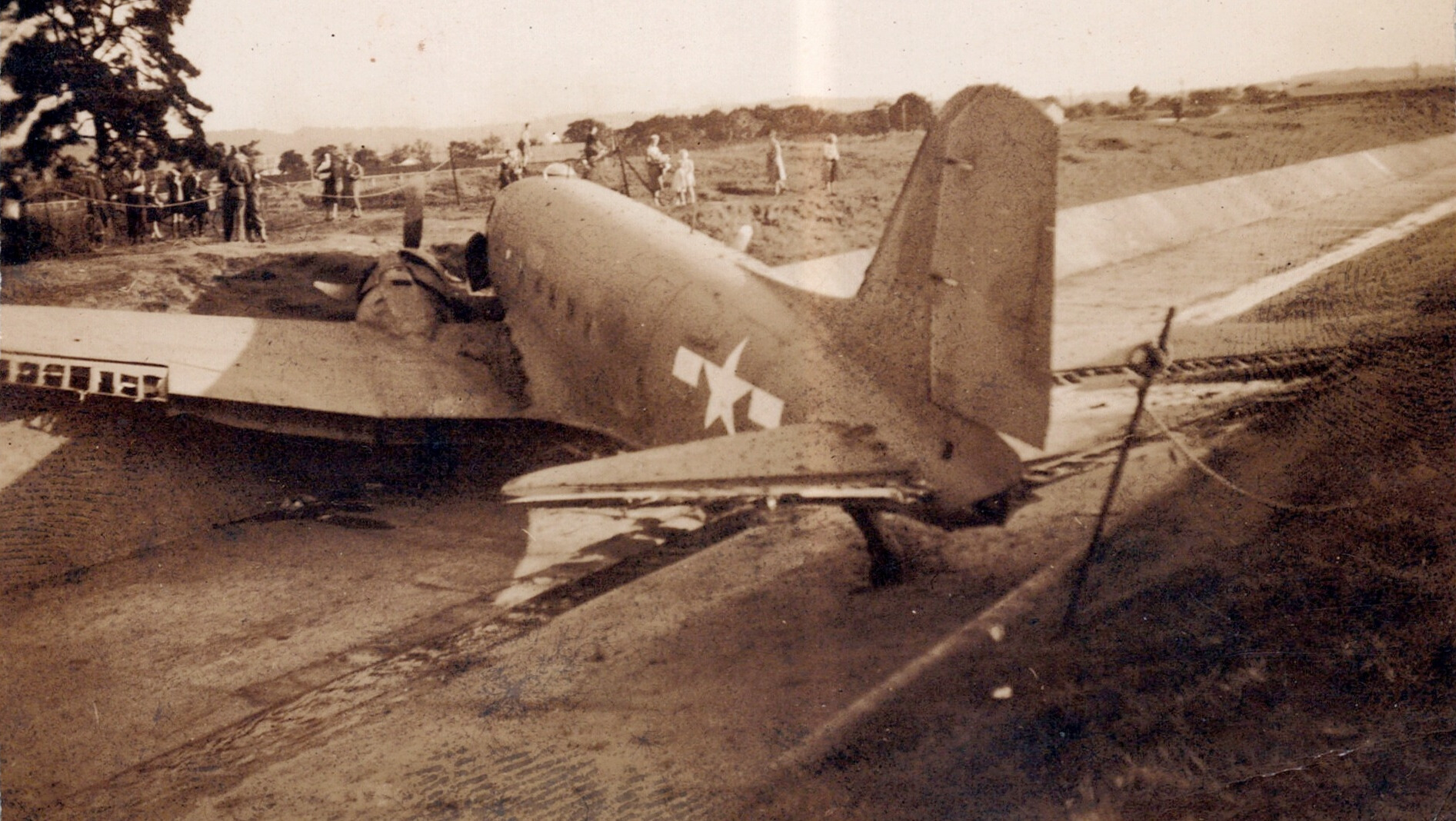
The Douglas C47 in a stormwater channel in Broadmeadow in 1944. Photo | Lost Newcastle Collection
On 10 August 1944, wartime skies over Newcastle brought an unexpected emergency – not from enemy fire, but from an unpredictable storm.
A United States Army Air Forces C47 transport plane – the military version of the Douglas DC3 – was carrying a total of 25 men (4 crew and 21 bomber squadron members on leave). While attempting to land at Broadmeadow Aerodrome near Newcastle, the aircraft encountered a violent storm that severely impaired its descent.
Despite the crew’s best efforts, the plane skidded around 200 yards across the aerodrome during the stormy, wet conditions. The landing was uncontrolled and ended with the aircraft caming to a rest in a stormwater channel or drain, just beyond the runway.
Remarkably, all 25 service members survived, though several sustained injuries. No fatalities were reported.
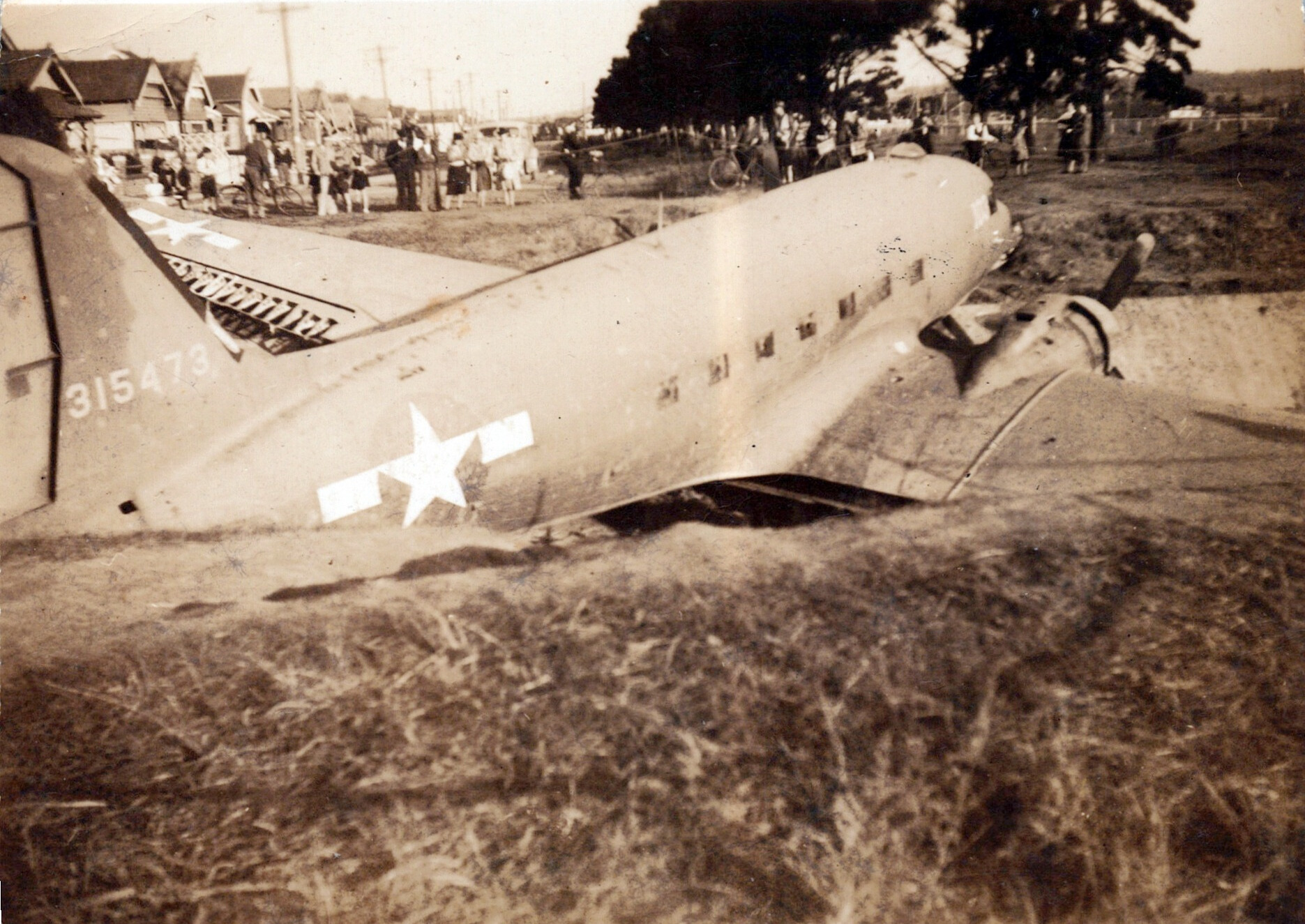
The damaged aircraft remained stranded in the drain, and early onlookers from Broadmeadow and Newcastle flocked to witness the aftermath. The sight of a US military plane drew considerable attention, just like the 2007 stranding of the Pasha Bulker on Nobbys Beach.
The Douglas C47 in the drain at Broadmeadow. Photo | Lost Newcastle collection.
In the media:
“A US Army transport plane, making a forced landing in a storm at Newcastle yesterday, crashed into a stormwater channel at Broadmeadow aerodrome” .
Trove article 11 August 1944
Full text of article
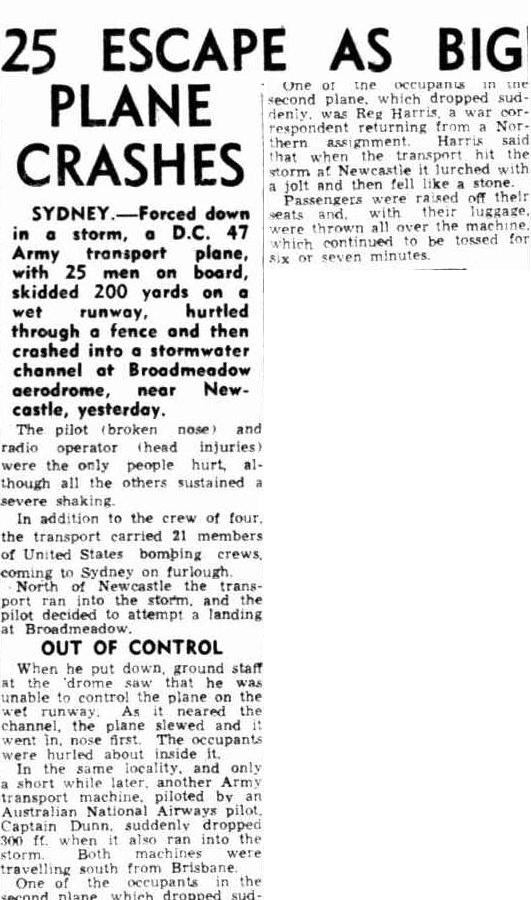
25 ESCAPE AS BIG PLANE CRASHES SYDNEY.-Forced down in a storm, a D.C. 47 Army transport plane, with 25 men on board, skidded 200 yards on a wet runway, hurtled through a fence and then crashed into a stormwater channel at Broadmeadow aerodrome, near New castle, yesterday. The pilot (broken nose) and radio operator (head injuries) were the only people hurt, al though all the others sustained a severe shaking. In addition to the crew of four, the transport carried 21 members of United States bombing crews coming to Sydney on furlough. North of Newcastle the transport ran into the storm, and the pilot decided to attempt a landing at Broadmeadow.
OUT OF CONTROL When he put down, ground staff at the ‘drome saw that he was unable to control the plane on the wet runway. As it neared the channel, the plane slewed and it went in, nose first. The occupants were hurled about inside it. In the same locality, and only a short while later, another Army transport machine, piloted by an Australian National Airways pilot. Captain Dunn, suddenly dropped 300 ft. when it also ran into the storm. Both machines were travelling south from Brisbane. One of the occupants in the second plane, which dropped sud denly, was Reg Harris, a war cor respondent returning from a Northern assignment. Harris said that when the transport hit the storm at Newcastle it lurched with a jolt and then fell like a stone. Passengers were raised off their seats and, with their luggage, were thrown all over the machine, which continued to be tossed for six or seven minutes.
Though no plaque marks the drain today, the story lives on through survivors’ accounts, newspaper clippings, and family lore. If your family has ties to this August 1944 event – letters, photos, or memories – we’d love to hear from you! Pop your stories in the comments below.


0 Comments